
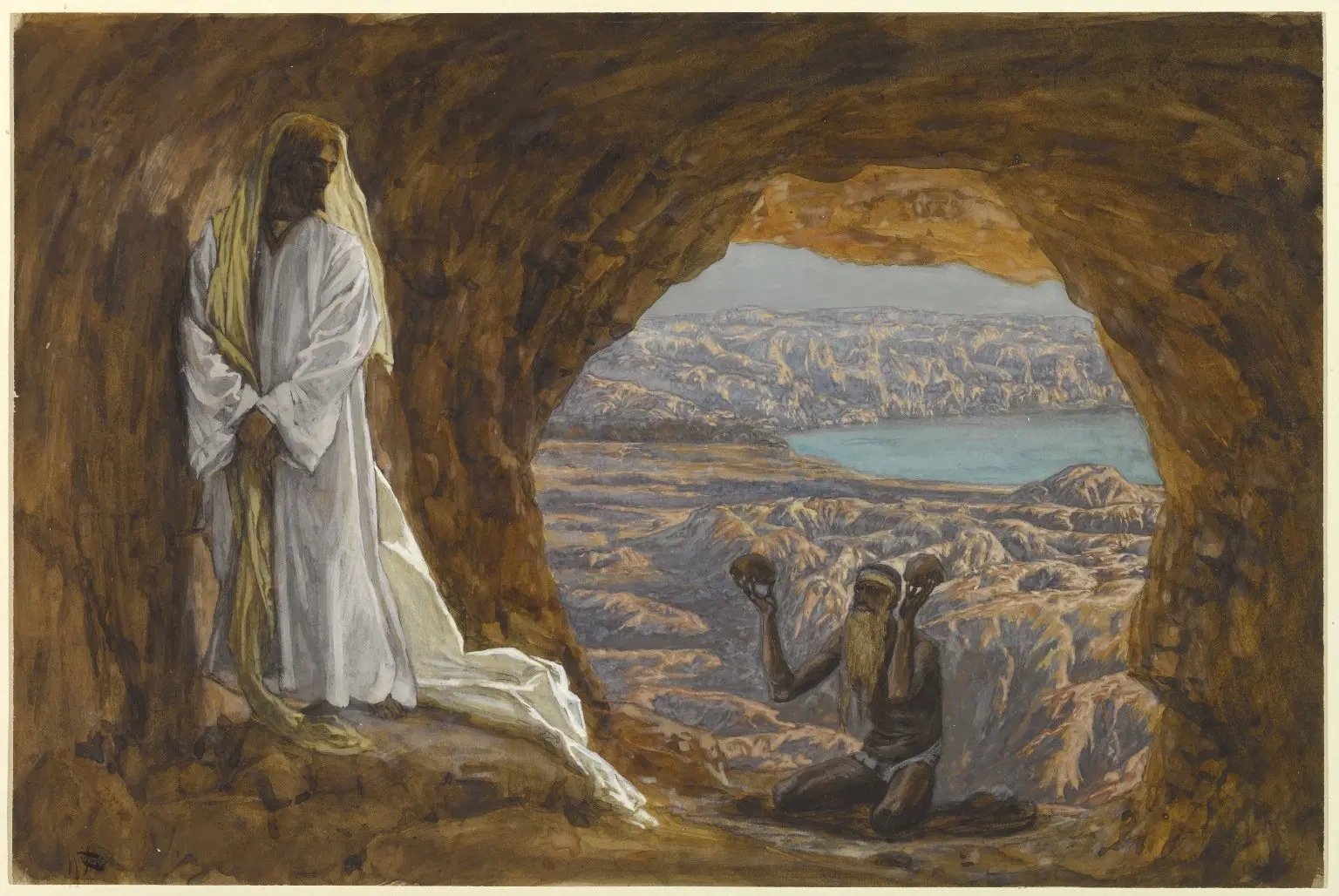
At that time Jesus went into the desert to be tempted by the devil. This was not an accident, not a detour, and not a moment of spiritual weakness—it was a deliberate step into battle. Why did He go to be tempted? This was His purpose in going into the desert. We often think He went there to make a nice retreat and that the devil came in to ruin it. But He went to enter into combat with the devil.
Saint Paul gives us the playing field when he speaks about Adam, the first man, and Christ, frequently referred to as the second Adam or the new Adam. What Adam failed to do in the first test, Our Lord succeeds in this one. He goes out into the desert to be tempted and to enter this time of testing in order to undo the failure of Adam. Where Adam failed to trust, Our Lord trusts. Where Adam gave in to the suggestions of the evil one, Our Lord resists.
He goes into the desert first to undo the failure of Adam, but also on our behalf—to give us an example and to win for us the victory over Satan. He was led into the desert to be tempted by the devil for these reasons.
What is the temptation He faces? In a sense, it is the same one Adam faced. The devil is not that creative. He is always a one-trick pony, always trying to compromise our trust in our heavenly Father—always trying to drive a wedge between us and the Father.
What are his first words of temptation? “Did God really tell you not to eat from any of the trees in the garden?” He is simply planting a seed of doubt in the mind of Eve—and, by extension, Adam. This seed of doubt is meant to grow into doubt about the Father’s goodness. That is the root of all his temptations: getting us to doubt the Father’s goodness.
Is He really good? Does He really desire what is good for me? Is He truly working for my good?
This is always his tactic. As a result, he tempts us to take matters into our own hands—to push God out of the way and take control. I begin to doubt God’s goodness and think I can do a better job myself.
With Adam and Eve, he plants that seed of doubt, and then he gets them to seize the fruit of the tree of the knowledge of good and evil. He convinces them that God does not truly have their best interests at heart, and so they must take the initiative. We have the saying that God helps those who help themselves. No—God helps those who respond to His initiative, who respond in faith and trust in His goodness.
The devil deceives Adam and Eve by promising that eating the fruit will make them like gods, and that God is holding this back from them. In reality, the very thing God wants to share with them is His own life. But instead of receiving it, they grasp for it themselves.
The first temptation insinuates that if Jesus is the Son of God, then He can do anything.
“If you are the Son of God, command that these stones become loaves of bread” (Mt 4:3). This is the temptation of self-sufficiency—of not needing anyone, of not having to ask, receive, or give thanks. It is the temptation of a son who does not really need the Father.
The second temptation insinuates that if Jesus wants to be sure He is the Son of God, the Beloved Son, He must put the Father to the test.
“If you are the Son of God, throw yourself down. For it is written: He will command his angels concerning you, and with their hands they will support you, lest you dash your foot against a stone” (Mt 4:6). It is the temptation of a son who cannot trust the Father.
The third temptation insinuates that even if Jesus is the Son of God, He has nothing and can do nothing. The Father does not share His riches with Him; the Father does not give Him what He needs. Instead, He must engage with evil in order to live fully: “All these I shall give to you, if you will prostrate yourself and worship me” (Mt 4:8). It is as if being a son were not enough to be blessed.
These three temptations touch deeply on three human fears.
The first reveals our most primordial fear: the fear of lack—the feeling that if we do not secure what we need ourselves, no one else will. It is the fear of not being supported, of not being loved enough to depend on others.
The second reveals the underlying fear that God does not truly want our good—that He is not really “God with us.” From this comes the need to constantly test Him, as though He must prove that He is trustworthy.
The third reveals the fear of not being good enough, of being insignificant. Sin insinuates that if you do not have everything, if you cannot do everything, then you are worth nothing.
Jesus, however, does not live in fear or anxiety. He lives in His relationship with the Father, and this is His true wealth. He responds to temptation always with Scripture—not as a weapon with which to fight, but as a deep orientation of the heart. Because He is Son, He knows the voice of the Father. And He knows that it is a voice that does not instill fear and demands nothing.
Lent leads us into the desert so that we may learn to recognize, among the many voices we hear, the voice of the Father. But how can we do this? What guidance does today’s Gospel give us?
The account of the temptations tells us that the Father’s voice never pushes us away from who we are. It never asks us to become someone else. It desires only that we become what we are: children—loved, capable of trust, capable of asking.
To overcome temptation, therefore, we do not need to be stronger than evil.
We simply need to return to listening to the Word of the Father, who calls us by name, who reveals to us who we are and what we truly desire.

Rev. Donald Brick, OCD
Ferris State College, B.A., 1983
Catholic Theological Union, M.Div., 1999
Profile See all posts© 2026 All Rights Reserved
Site by 