
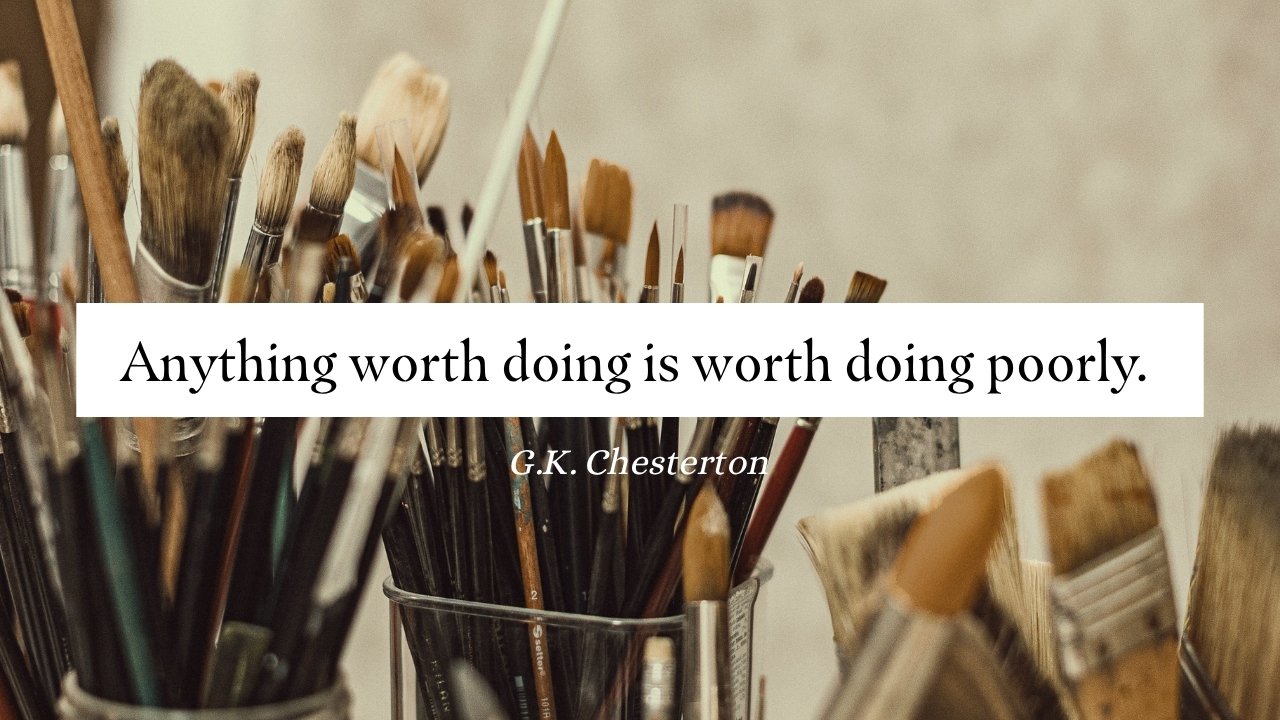
Anything worth doing is worth doing poorly.
This thought comes from G.K.Chesterton, and he is not alone in asserting this. A more contemporary if less obviously Christian expression of this sentiment can be found in the book (It's Great to) Suck at Something: The Unexpected Joy of Wiping Out and What It Can Teach Us About Patience, Resilience, and the Stuff that Really Matters (Karen Rinaldi, Atria Books, 2019).
Chesterton’s point was that we can greatly enrich our lives by pursuing activities even if we are not yet expert at them. Chess should be played and enjoyed even by those who lack the rank of grandmaster. Racquetball (I date myself, even if Boston College built beautiful courts during my time at seminary) should be played even by those who cannot compete in an open-level tournament. To fail to do such inexpert things is to deny yourself wholesome fun and to risk eternity: most importantly, Christianity should be practiced even before it is perfected. Short of heaven, it’s hard to think any of us will find a perfect practice of it in this life. Even Saint Francis warned against canonizing him too quickly.
As Chesterton also observed, Christianity has not been tried and found wanting; is it has been found difficult, and left untried.
There is a deeper point of reflection here on the dignity of human work. Earlier this month, the Church celebrated Saint Joseph the Worker and pointed us to the inherent dignity of human work. Of course, we start with the notion of the inherent dignity of every human person, being created in God’s image and likeness. The dignity of human work follows from this inherent dignity as act follows being. (Agere sequitur esse.)
This is a difficult reality to ponder given the economic realities of the 21st century. It is far easier to think that the dignity of work comes from the monetary value assigned to its compensation. When we race to outlets like Walmart and Amazon to reduce the cost of our own consumption, we imitate the labor markets of the early industrial revolution that sought to obtain as much work from human labor as possible at the minimum cost. The last Pope Leo reminded us all then in Rerum Novarum that we couldn’t just see labor as another part of the soulless supply chain. Those who labor have inherent dignity, as does the work, and everyone needed to remember that. We still do.
There is some irony in that, today, the tendency to see human actors as impersonal cogs in a machine is not so much in industrial labor but in the practice of medicine. Doctors and nurses are not mere units of medical economic activity but human agents whose work bears moral weight. Political discourse in this country, such as it is, is rife with talk of rights and seldom considers the consequent responsibilities. Political arguments in support of such so-called “rights” to so-called “medical care” never seem to weigh the legitimate conscience rights of the medical professions expected to perform such “care.” The professional actions of those doctors and nurses have the inherent dignity of human work, and that work has an intrinsic moral character. The Hippocratic Oath to “do no harm” once made by medical professionals follows from synderesis, that primordial conscience that instructs us all that we should do good things and not do evil things. For patients to exercise their “rights” is not sufficient grounds to force medical professionals to violate their consciences.
In fact, the responsibility that can be attached to human work enhances its dignity. Our society ensures that people are properly trained before licensing them to operate dangerous 3,000+-pound machines at high speeds in close proximity to each other. (I still remember driving in Boston.) Failure to operate vehicles safely is a violation of the public trust, and can cost lives; drivers can face criminal charges in those circumstances. No programmer of a supposedly-self-driving vehicle who makes a mistake will ever face the same prospective consequences as a human driver that makes one. The economic term to describe this reality is moral hazard: to fail to properly account for risk when someone else faces the consequences. The inherent dignity of human life, and the danger presented to it by operating vehicles, suggests that there is a limit to how much human safety should be ceded to artificial intelligence.
Another of our modern truisms is that time is money. For the student of today, the temptation is to understand the value of education in the economic terms of minimizing the effort needed to obtain it. To use artificial intelligence to “write” an essay is to minimize the human effort (and thus the cost) needed to produce it. The problem here is that the student has not done the work. The work of a student forms him. He is changed by the experience. To omit the effort of doing the work for a degree is for the student to deny himself the best part of his education: the learning that no one can take from him.
There is one last observation to include. For the Christian, charity further elevates his work. When done for love of God or neighbor, even simple tasks can merit a reward (cf. Mt 10:42). We have also the suffering patiently endured (see the second reading appointed for the Seventh Sunday of Easter, 1 Pet 4:13-16), but surely also work done with charity can be offered as a spiritual sacrifice (cf. Col 1:24, 1 Pet 2:5, Rom 12:1). What more dignified work is there for us to undertake than the worship of God?
I was asked to contribute to this weekly email from Saint John’s Seminary as I approach my fifth anniversary of ordination to the priesthood. The topic of work-done-poorly was not the first to come to mind. But like the student seeking to minimize the labor, I had already wanted to assay this topic. The invitation simply gave it a second audience.
But the subject does seem apt.
I entered the seminary after a 14-year career in higher education. I thought it was a good idea to leave my job, go back to graduate school for seven years, and reenter the workforce at a 50% pay cut. I shared some lessons learned by giving a presentation to my former colleagues at a conference in 2023. My 10-minute lightning talk was titled “If I knew then what I know now: confessions of a recovering Web professional.” Clearly, I understood then and now that the dignity of my work was not defined by the size of the paycheck.
Some of the last work on the Saint John’s Gradual was completed with a computer program that I wrote. I’m not beyond writing a digital tool to save me from a tedious task that almost anyone could perform – even at the cost of more time to write the tools. I even have some planned enhancements to these tools in progress. Certainly, lives are not at stake when these digital tools are used. And when developed, such tools can help me save time required to elevate the worship of God in other contexts.
As I think back on my priestly ordination, the unexpected grace I most recognize is an opening of my lips as a preacher. I preach differently as a priest than I did as a deacon. But grace builds on nature. As I approach this task, it was assignments in classes other than homiletics that I seem to draw upon. Thank you Dr. Orlando for the church history essays! They were formative. They were a joy to write then. It is a joy to preach now. (I still have not used ChatGPT or any other modern AI software so far as I know.)
In the end, any vocation is rooted in mystery. God does not call the equipped, but He equips those whom He is pleased to call. Hillaire Belloc once referred to us churchmen as knavish imbeciles, and I am relieved to have remarkably small audience for my particular flavor of imbecility to impact. And yet, I feel as imperfect as I am, the desire to please God pleases Him. As Christ tells the Father in this weekend’s Gospel, “I glorified you on earth by accomplishing the work that you gave me to do” (Jn 17:4). Please pray for me. May I remain ever confident as Saint John Henry Newman, “He has committed some work to me which He has not committed to another. I have my mission. I may never know it in this life, but I shall be told it in the next.”
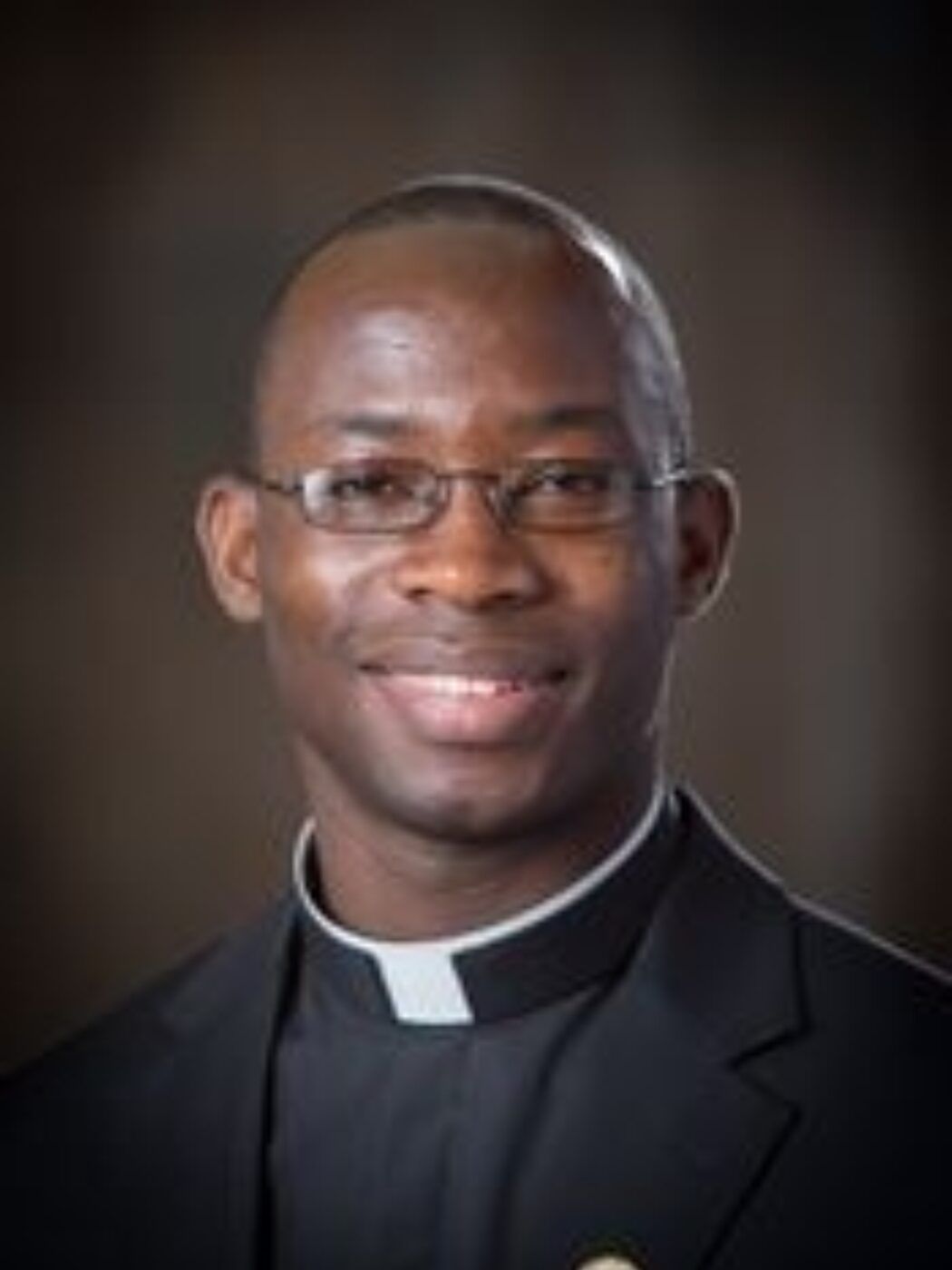
Rev. Stanislaus Achu
St. Joseph Major Seminary, B. Phil., 2015
Saint John’s Seminary, M.Div., 2020; S.T.B., 2020
Boston College School of Theology and Ministry, S.T.L., 2024
Profile See all posts© 2026 All Rights Reserved
Site by 