
Oftentimes, when you go to see a play, there is an intermission between major parts of the performance. And you go out to the lobby and stand around chatting about what’s happened so far: what particularly struck you, which actor did a really great job, what scene especially moved you. And you also talk about what’s coming: how you think the play will resolve itself in the final act. Will it be a happy ending or will the curtain fall on a tragedy?
This weekend, the Seventh Sunday of Easter, is sort of like an intermission in the mystery that we’ve recently been living in company with the Apostles. The first act consisted in the drama of Holy Week, in which we witnessed the immense love of Jesus poured out in the Last Supper: the institution of the Eucharist, the washing of the feet, the ordination of the Apostles as the first bishops of the Church. The betrayal orchestrated by Judas. The passion and death of the Lord. His burial in a borrowed tomb. And then the remarkable second act: the empty tomb, the risen Christ revealed to Mary Magdalene. Then to the disciples on the way to Emmaus. In the Cenacle, the Upper Room. By the shore of the Lake of Tiberias. Reconciling the apostles who betrayed Him and ran away into the night. He sends them forth as witnesses to the nations. And then He ascends to heaven, bearing with Him the human nature which He assumed within the womb of the Blessed Virgin Mary. And then the clouds conceal Him from our sight. Intermission.
This Sunday is our intermission between Ascension Thursday and Pentecost Sunday next weekend. And so, we take this occasion to both look back at what we have just recently experienced, and we look forward to what lies ahead.
The past forty or so days since Easter Sunday have been a non-stop celebration of Christ’s victory over the grave. Our joy is proportionate to the seriousness of what Jesus did for us. What could be more serious than death? It’s what human beings fear most. It seems to be the ultimate end of everything good, this ineluctable force which pries loved ones out of our reach, which definitively destroys, and which is coming for each of us.
By submitting to an unmerited death and then being raised to life in His human body, Jesus changed the meaning of death from the inside out. Death is no longer the end, but rather an entry into eternity. It becomes a passage from one mode of being to another one, a higher one, more beautiful, more full. And, provided that we are united to Jesus, we don’t need to fear death anymore. In the words of St. Paul, “Christ, having died once, dies no more. Death has no more power over Him. His death was death to sin; His life is life for God. We too should consider ourselves dead to sin but alive to God in Christ Jesus.”
In today’s Gospel, Jesus speaks of what it is that He aimed to accomplish during His time among us. “Give glory to your son, so that your son may glorify you, just as you gave him authority over all people, so that your son may give eternal life to all you gave him. Now this is eternal life, that they should know you, the only true God, and the one whom you sent, Jesus Christ.”
The possibility of eternal life, won for us by Jesus, means that the fundamental characteristic of the Christian life is joy. Joy because death has been defeated, sin overcome, and we have been given access to this new life, this new peace, not having earned it, but as a pure gift.
Having celebrated this joy that has come upon us, we also look forward to the next act: the coming of the Holy Spirit at Pentecost, which we will celebrate next Sunday. The Holy Spirit comes to dwell within the Christian to enable him or her to transfer the joy of the Resurrection into action. It is the Holy Spirit that inspires and moves us to share the reason for our hope with others, so that they too might experience the same joy that comes from a relationship with the living Jesus.
Our First Reading shows us how to prepare to celebrate this next feast well. “All of these devoted themselves with one accord to prayer, together with…Mary the mother of Jesus…” Who better to teach us how to receive the Holy Spirit than she who received Him first? In this month of May, Mary is always on our minds and in our hearts. She is a perfect model of what it means to follow Jesus wholeheartedly.
And so, in this coming week, let us strive to stay close to the mother of Jesus as we await Pentecost with joyful expectation. And as we offer this eucharistic Sacrifice, we ask that Holy Spirit be sent to us anew, that the whole earth may be enkindled with the living flame of God’s love.
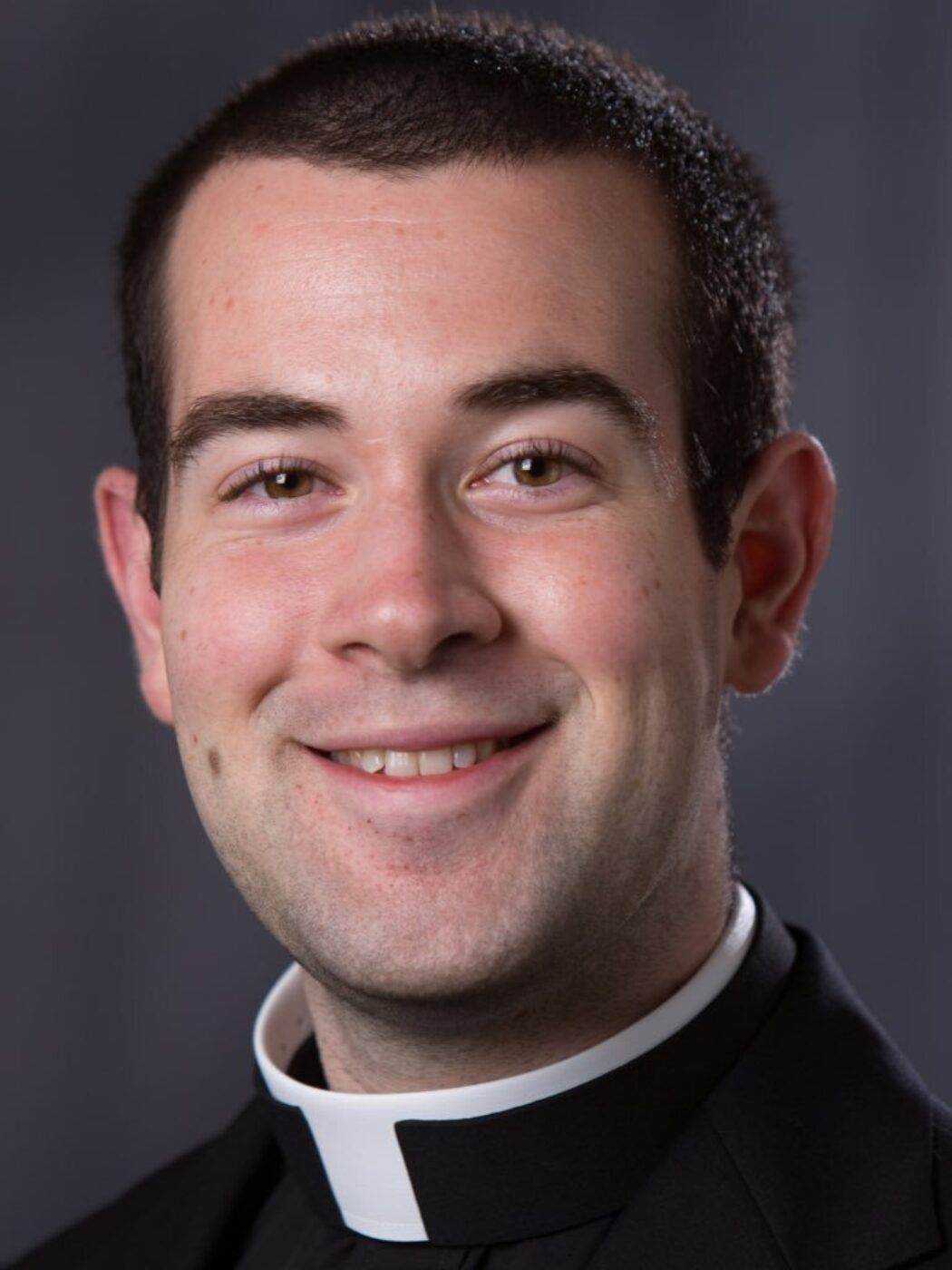
Rev. Peter Stamm
Boston College, B.A., 2008
Saint John's Seminary, M.Div., 2015
Boston College, S.T.L., 2023
Courses Taught at Saint John's: Introduction to Sacred Liturgy, Practicum in Ars Celebrandi, Latin II, Spiritual Theology, Catechism Parts III & IV.
Profile See all posts© 2026 All Rights Reserved
Site by 