
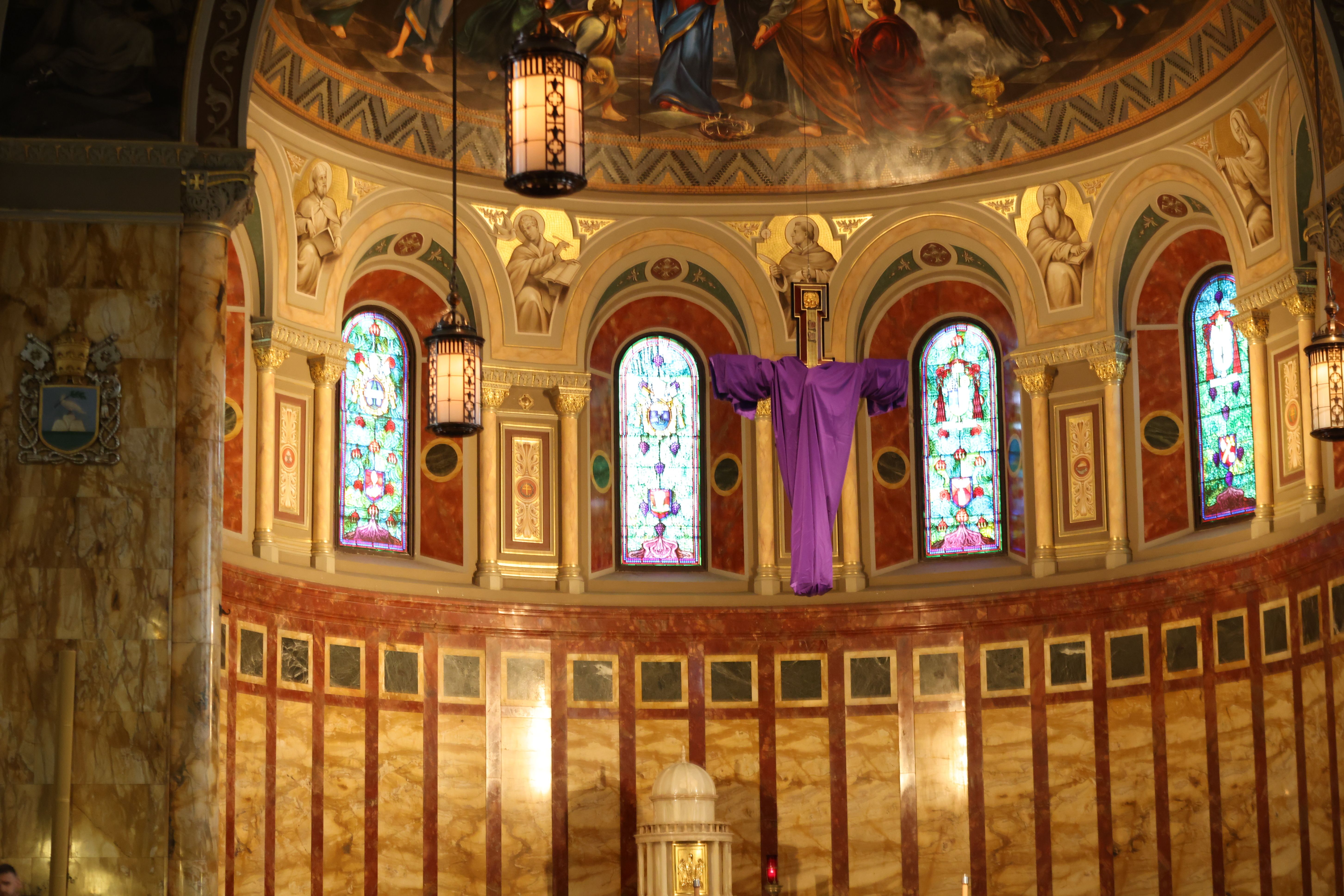
So it begins. The purple veils which shroud the cross and statues of our churches signal to the Catholic faithful around the world that the days of our Lord’s Passion, Death, and Resurrection are drawing ever nearer, the days in which, when lifted up, Christ draws all to Himself. In light of today’s Gospel, in which is recounted the raising of Lazarus from the dead, these veils remind us of the burial shroud, the cloth that will rest upon each one of us one day, a sign of the inexorability of death, but a reminder also of the burial cloths laid aside in Christ’s empty tomb, and the command spoken in today’s Gospel: “Untie him and let him go.”
A momentum has been building over the past weeks of Lent. Two Sundays ago, Christ met the Samaritan woman at the well, alone and thirsting. He offered her living water, and her whole community came to Christ through the witness of her word. Last week, Jesus gave sight to the man born blind, simultaneously exposing the spiritual blindness of the Pharisees. Each week, the situations Jesus encounters become more dire but in them His power is even more magnified and His identity becomes clearer to those with eyes to see. Today, it is Lazarus who is in need, not alone, not blind, but rather entirely dead. And so Jesus comes to wake him.
It is in the context of this Gospel that the catechumens (those preparing for Baptism) throughout the world are undergoing the third and final Scrutiny today, in which they affirm their faith and accept the Church’s prayer for their separation from their old lives of sin. As they turn from what is old, they are given this great vision of Jesus, who holds the mastery over life and death. He is the One who has the power to bring about life even in the midst of death. It is at the entrance to the tomb that Christ shows Himself to us as most truly human and most truly divine.
Christ is shown as truly human. I can think of no other passage in any of the Gospels where Jesus’ love is mentioned so many times in one place. “Master, the one you love is ill.” “Now Jesus loved Martha and her sister and Lazarus.” “Jesus wept. So the Jews said, ‘See how he loved him.’” At the death of Lazarus, whom Jesus calls “our friend,” He is deeply perturbed, deeply troubled. He is moved. He feels sadness, sorrow, compassion. He looks upon his friend Mary weeping, the crowd weeping, and He weeps with them. Could there be anything more human?
If we ever feel that God is in some way distant to our suffering or the suffering of so many others, today’s Gospel is for us to take to heart. If we are tempted to think that God’s perfections are incompatible with true compassion, that because He knows all things and how all things move toward a final triumph of good that He looks upon our tears with a blank indifference, think again. The tears of Jesus are our comfort in sorrow, a pledge that we are not alone amidst the reality of suffering and death. When God stands with us at the entrance to the tomb, He doesn’t explain it away. He cries with us. But that is not all He does.
Jesus approaches the tomb of His friend Lazarus. You perhaps picked up the eerie details of how the tomb is described as a cave with a stone rolled over the entrance, just like another tomb Jesus will be encountering soon. This is not a coincidence. He stands there as they roll aside the stone. Picture what He sees before He begins to pray. He looks into the mouth of the cave, and He sees a dark, black abyss. The very epitome of death. He sees a mouth open and hungry. The grave is always waiting to swallow another body, to consume and destroy. When someone enters into that dark place, they are never seen again.
With the stone rolled aside and the maw of the abyss lying open before Him, Jesus begins to pray. “Father, I thank you for hearing me. I know that you always hear me.” Death seems to have the power to sever all bonds, to separate people from their loved ones, to take them apart.
But it is precisely here where Jesus reaffirms His bond with the Father. Death cannot break this. Rather, death will be broken by this. It is death that will become but a shadow of its former self.
“Lazarus, come out!” Into the darkness, Jesus calls His friend by name, and the dead man emerges alive. In that most hopeless of all places, a tomb, something new is happening. If Christ’s power reaches even here, then it truly does reach anywhere. Seeing this immense miracle, one is entirely reasonable to accept the claims Christ makes concerning His identity as true man and true God. It is reasonable to put all our faith and hope in Him.
The raising of Lazarus sets in motion a chain of events which will bring Christ in and out of His own tomb. As this miracle sets off an uproar ahead of the celebration of Passover, Caiphas the high priest will look to put Jesus to death to avoid the possibility of an uprising and a Roman crackdown. The multitudes of people converging on Jerusalem to purify themselves ahead of Passover, will hear about this miracle and welcome Jesus with palm branches, hoping that He is the Son of David, the one who is to come. The hour of Jesus draws near.
May we eagerly walk in that same charity with which, out of love for the world, Jesus handed Himself over to death.
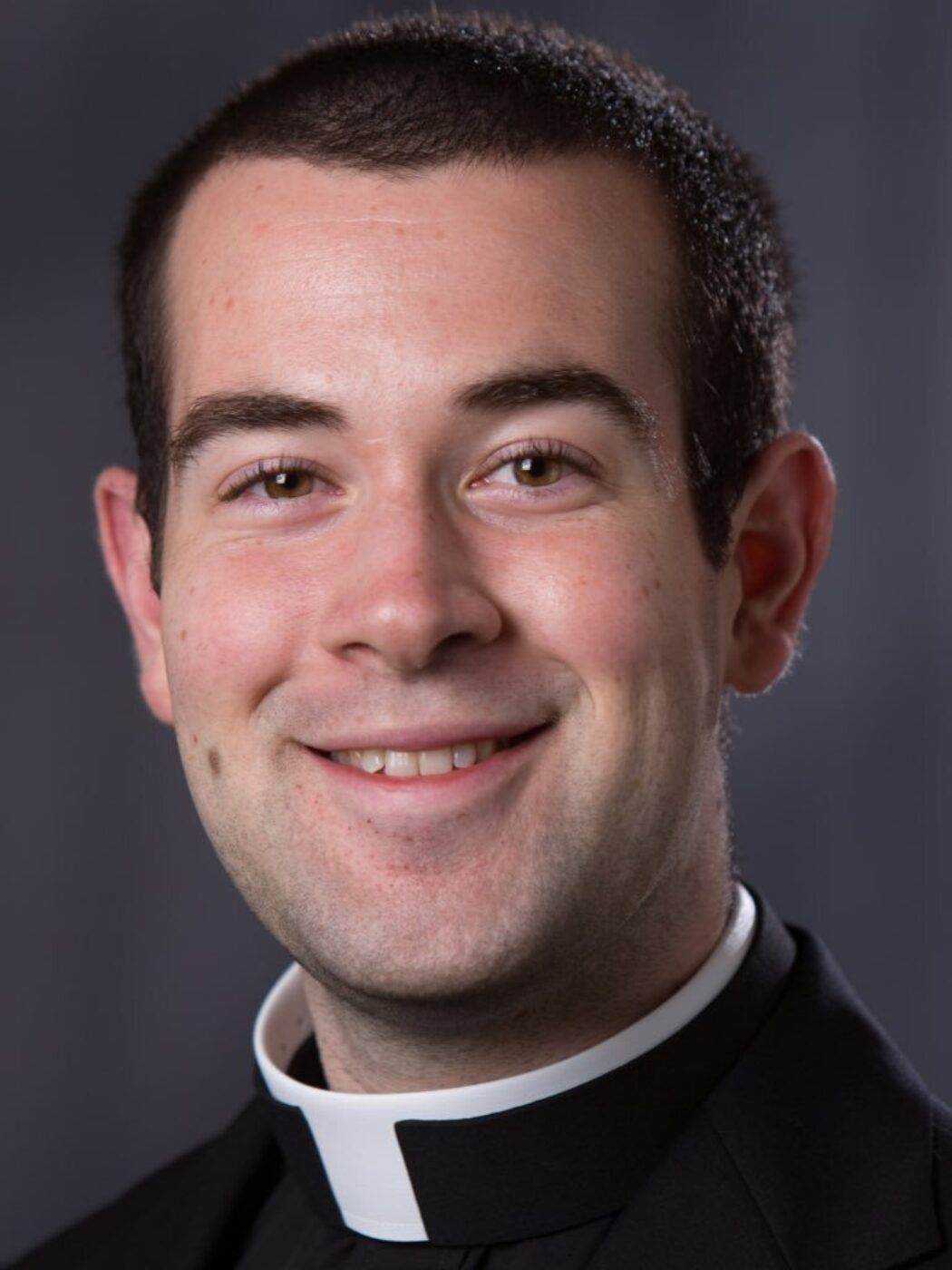
Rev. Peter Stamm
Boston College, B.A., 2008
Saint John's Seminary, M.Div., 2015
Boston College, S.T.L., 2023
Courses Taught at Saint John's: Introduction to Sacred Liturgy, Practicum in Ars Celebrandi, Latin II, Spiritual Theology, Catechism Parts III & IV.
Profile See all posts© 2026 All Rights Reserved
Site by 