
By: Deacon Jay Zizza, Class of 2026
The entry into Jerusalem is classically understood as the entrance of the coming Messiah, the son of David who is praised as a king. However, I would argue it is at the cleansing of the Temple that His entrance as Messiah is made complete. This is because for many Dead Sea Scroll manuscripts, the Messiah is not only the Son of David who is praised as king, but the true high priest who cleanses and restores the worship of God.
The Messiahs of the Dead Sea Scrolls
In biblical scholarship, the finding of the Dead Sea Scrolls was like hitting the lottery. Their discovery wasn’t a product of some archaeological dig, but rather a very lucky chance. In 1947, a young shepherd found them simply by throwing stones into caves searching for his lost livestock.
But, in these caves contained not mischievous, hiding goats, but rather redefining manuscripts called the Dead Sea Scrolls. They are currently the oldest manuscripts we have of several Hebrew Scripture passages. But also, more importantly for this argument, religious writings from different Jewish communities during the Second Temple Period (the time when the Second Temple was built about 516 BC to about when it was destroyed 70 AD). This gave us particular insight on how Jews during Jesus’ time interpreted Jewish law, approached the Scriptures and understood Messianic expectation.
There is one fundamental text called the Community Rule that states that Messianic Age “shall come [with] the Prophet and the Messiahs of Aaron and Israel” (1QS 9:11). While within the context of other manuscripts in the Dead Sea Scrolls, there is debate on whether there is an expectation of one or two messiahs, it is clear that the Messiah will serve identities: The Messiah of Israel and the Messiah of Aaron.
Messiah of Israel
There is a consensus among many manuscripts that the Messiah of Israel is a conquering king who will free Israel from the oppression of other nations (Collins, 67). The Psalms of Solomon invoke the Lord to raise up this king of Israel to purge Jerusalem from gentiles (Ps Sol. 17:21). The Pesher on Isaiah sees that this king of Israel will have victory over all the nations after a final battle with the Kittim [Westerners] (Collins, 57). The Scroll of Blessings includes a blessing for this messianic king in his efforts to destroy all the other nations (Collins, 60).
Messiah of Aaron
While not a consensus like the Messiah of Israel, some manuscripts point to a Messiah of Aaron as a high priest who will free Israel from the ineffectiveness and even corruption of “the current High Priest and the operation of Temple cult” (Collins, 95). However admittedly, this Messiah of Aaron is usually only recognized by priestly manuscripts and communities within the area of the Dead Sea Scrolls themselves. Nonetheless, one can argue from the Dead Sea Scrolls that at least within part of the Jewish imagination, there is a Messiah who is both a conquering king and a restorative high priest.
Entry into Jerusalem – Messiah of Israel
In light of the anticipation of this Messiah of Israel, a conquering king who will come to smite the other nations, one can now look to the entry of Jerusalem. In Matthew in which our Sunday Gospel draws from, Jesus’ entry is often understood as a humble king entering Jerusalem with the words of Zechariah 9:9:
“Tell the daughter of Zion,
Look, your king is coming to you,
humble, and mounted on a donkey,
and on a colt the foal of donkey.”
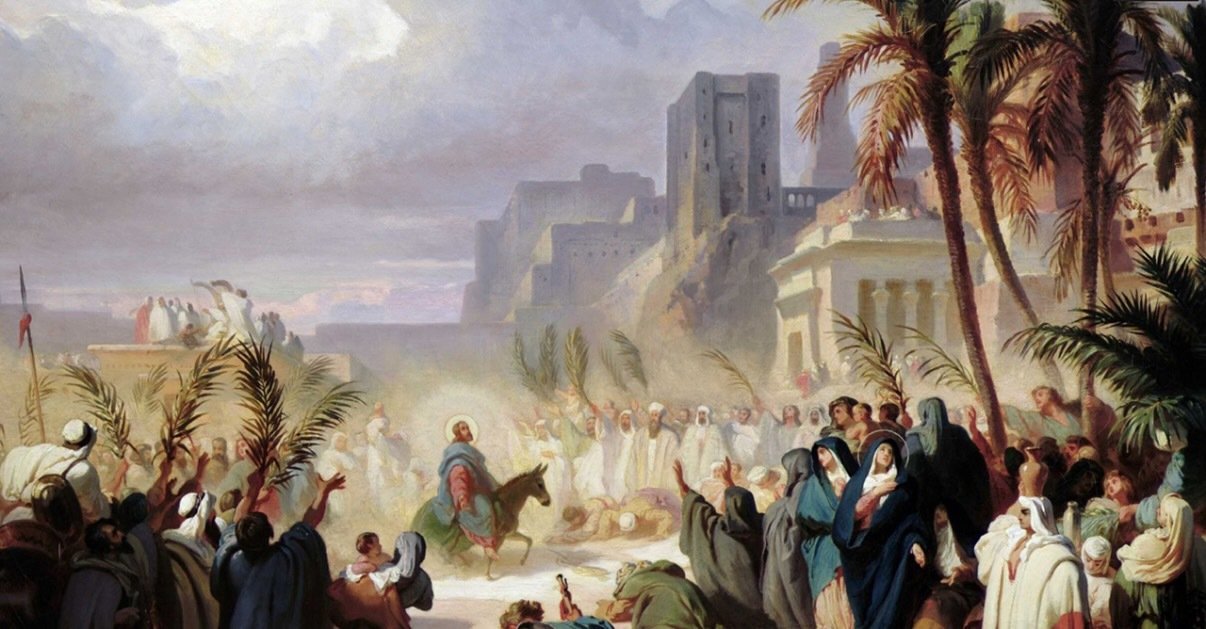
At first, the king seems to be humble and peaceful, however, the prophecy of Zechariah itself in Chapter 9 connects violent conquering with the coming of this king. To name a few instances: Tyre will be consumed by fire (Zec. 9:4), Gaza will writhe in agony, Ekron’s hope will wither. (Zec. 9:5). In light of this Matthew could be using Zechariah in two ways. First, Matthew could be pointing to Zechariah 9:9 independently to emphasize the peaceful entry of Jesus. Second, Matthew uses Zechariah 9:9 to allude to all of Zechariah’s prophecy to invoke a later spiritual conquest against the conquering ‘nations’ of evil, death and Satan.
While Matthew’s intention may be unclear, the Jews’ reaction is more direct. Their crying out, “Hosanna to the Son of David! Blessed is He who comes in the name of Lord!” (Matt. 21:9) points to an anticipation of a Davidic king who brings deliverance. And the type of deliverance is found in the context behind the words of the Jews. “Hosanna [or Save us!], Blessed is he who comes in the name of Lord” points to Psalm 118:25-26 (Cambridge Bible). This Psalm like Zechariah 9 points to salvation and deliverance through the ‘cutting down’ of the surrounding nations.
Unlike Matthew whose use of Zechariah can be argued in different ways. Psalm 118:25-26 has a liturgical tradition behind it. In several Jewish feasts, Psalm 118:25-26 is used within the entirety of Psalm 118. The Jews knew this psalm by heart and was “associated with the exodus, the end of captivity, and David” (Vaillancourt, 734). In light of this, there is a strong possibility for the Jews to recognize Jesus’ entry into Jerusalem as some form of entry of a Messiah of Israel or a Davidic conquering king associated with the end of their captivity under the Roman empire.
Cleansing of the Temple – Messiah of Aaron
In Matthew, the cleansing of the temple occurs after the Entry into Jerusalem. As said before, the Second Temple period was marked with discontent for religious leaders particularly the high priests (Collins, 95). The first century historian, Josephus, describes that the high priests were closely associated with or even influenced by Roman political interests as Roman rulers appointed and removed high priests themselves. In light of this, high priests were often tasked with making difficult compromises and convincing the Jews to undergo oppressive situations imposed by the Roman Empire like spontaneous taxation (Antiquities of the Jews, Book XVIII, 1.1).
The cleansing of the Temple is classically understood as a purifying of Temple worship particularly from the corruption of money changers. However, in light of this anticipation of a Messiah of Aaron who purifies the corruption of not only Temple cultic practices, but religious leadership in general, there is more at play. And one can see this in what Jesus says while cleansing the Temple: “For my house shall be called a house of prayer for all the nations? But you have made it a den of robbers” (Mat. 21:13).
Jesus is quoting both Isaiah 56:7 and Jeremiah 7:11. In Isaiah 56, Isaiah expands His covenant to all the nations. Isaiah says that if a foreigner is holy, then their burnt offerings will be accepted as the Temple will be called a house of prayer for all nations. In Jeremiah 7, Jeremiah rebukes Israel for believing that their Temple worship is bringing them security within the eyes of God while they oppress the vulnerable around them.
Jesus takes on both Isaiah and Jeremiah in the Temple. While not explicitly stated, Jesus cleanses what seems to be the Court of the Gentiles because it is the only place big enough in the Temple for such markets. (Cambridge Bible), So, Jesus is putting to work the words of Isaiah, cleansing the place in the Temple designed for Gentile worship that has currently been filled with marketplaces.
Second, “the blind and the lame came to Jesus in the Temple, and He cured them” (Matt. 21:14). Jesus rather than oppressing the vulnerable, heals them. And it is in this work, that children cry out, “Hosanna to the Son of David” (Matthew 21:15). The cry of children links Jesus’ work in the Temple to the entry of Jerusalem.
It is in both the context of the Messiah of Aaron, the one who restores religious practice and authority, and this “Hosanna” link between Jesus at the Temple and Jesus’ entry into Jerusalem that I ultimately argue that Jesus’ Messianic entry into Jerusalem is only complete with Jesus’ entrance into the Temple. Both the entry into Jerusalem and the entry into the Temple fulfill both expectations of the Messiah, the one who is king and high priest.
© 2026 All Rights Reserved
Site by 