By: Fr. Matthew Conley, Class of 2016
A Reflection on Seminary Formation, Ten Years of Priesthood, and the Call of Christ
Ten years ago, on May 21, 2016, I knelt before Cardinal Seán O'Malley and was ordained a priest of Jesus Christ. The next day, I celebrated my first Mass as a priest. It was Trinity Sunday. At the time, I could never have imagined how quickly ten years would pass, nor could I have fully understood what the priesthood would ask of me and what it would give in return.
Anniversaries invite us to look backward with gratitude and forward with hope. As I reflect upon eight years of seminary formation and ten years of priesthood, I find myself connecting to when Jesus asks His disciples a question that every Christian must answer: “Who do you say that I am?” (Luke 9:20). In many ways, that question has shaped every stage of my vocation.
My journey toward priesthood began long before I entered seminary. As a child, I remember standing in my parents’ living room wearing my father’s bathrobe and pretending to celebrate Mass with Wise potato chips and grape juice. Like many childhood memories, it seems humorous now, but even then, the Lord was quietly planting a seed. I did not fully understand what I was doing, but I knew there was something beautiful and important about priesthood.
That seed was nurtured by my family who supported my discernment even when they didn’t always understand it, my Catholic education, faithful priests, and countless people who encouraged me along the way. I especially remember a conversation with a priest during my sophomore year of high school. I was frustrated, confused, and searching for direction. He took the time to listen, answer my questions, and help me discern God’s will. Looking back, I realize how much that encounter mattered. Vocations are never lived in isolation. God often calls through the witness and encouragement of others. Eventually that call led me through eight years of formation at Providence College, Our Lady of Providence Seminary, and St. John’s Seminary.
Seminary formation is often misunderstood. Many people imagine it as simply studying theology or learning how to celebrate Mass. Those things are certainly important, but seminary is much more than an academic program. It is a process of allowing Christ to shape every aspect of one’s life.
Anyone who knew me during those years would probably admit that I was not exactly the typical seminarian. I had, and still have, a tendency to find humor in almost every situation. I enjoyed making people laugh, occasionally testing the patience of formators and classmates, and sometimes pushing buttons simply because they looked pushable. While I took my vocation seriously, I did not always take myself too seriously. Looking back, I am sure there were moments when those responsible for my formation wondered whether I would ever fully mature…. (I’m sure some are still wondering when it will take full effect).
One of the great gifts of seminary is that God works with the person He actually called, not the person we imagine we should be. Formation did not erase my personality. Instead, it taught me how to place those gifts, and even those quirks, at the service of the Gospel. Humor can build bridges, put people at ease, and remind us that holiness and joy belong together. There were moments of tremendous joy and moments of challenge. There were successes and failures, confidence and uncertainty. Yet throughout those years, the fundamental question remained the same: “Who do you say that I am?”
The answer could not remain merely intellectual. Seminary gradually taught me that Jesus Christ is not simply someone to be studied, but someone to be known, loved, and followed. Formation was ultimately about deepening a relationship with Him. When I was ordained, I thought I understood that reality. Ten years later, I realize I am still learning it.
Archbishop Fulton Sheen once wrote, “There is no ‘on duty’ for a priest.” Those words carry a different weight after ten years of priesthood than they did during seminary. Priesthood is not simply a profession. The priest belongs to Christ and to His people at all times.
Over the past decade, I have experienced that truth in ways both ordinary and extraordinary. I have celebrated hundreds of baptisms, witnessed beautiful marriages, anointed the sick, heard confessions, and stood at the altar countless times to celebrate the Holy Eucharist. I have stood beside hospital beds, gravesides, and family dinner tables. I have traveled throughout the world and witnessed the beauty of the Universal Church. Through it all, I have discovered that priesthood is less about what a priest does and more about whom he belongs to.
The people I have served have also taught me something important. They have patiently tolerated my stories, endured my occasional bad jokes, and kindly laughed at them far more often than they probably deserved. In return, they have shown me that joy is an essential part of the Christian life. A parish should be a place where people encounter the Lord, but it should also be a place where people experience the warmth and friendship that come from belonging to God’s family.
The greatest lesson of these ten years is not that I have held on to Christ, but that Christ has held on to me. There have been moments of exhaustion, disappointment, uncertainty, and sacrifice. Yet through every challenge, the Lord has remained faithful. He has repeatedly reminded me that the success of priesthood does not depend upon my strength but upon His grace. That lesson finds a beautiful connection with this weekend’s readings. As Jeremiah confidently proclaimed, “the Lord is with me, like a mighty champion,” and as Jesus reminds us in the Gospel, “Do not be afraid,”. The Lord is always with me and I’ve never been afraid of what may come next, thanks be to God!
In the Gospel, Peter answers Jesus’ original “who do you say that I am?” question by proclaiming, “You are the Christ of God.” Peter’s confession is correct, but Jesus immediately begins teaching the disciples that the Messiah’s path leads through sacrifice. That pattern is true not only for priests but for every Christian vocation.
The Christian life begins when we fix our eyes upon Christ crucified and allow His love to transform us. Saint Paul reminds us that through Baptism we have been clothed in Christ and are united as one family in Him. This should tell us that the central question of life is not what accomplishments we achieve or what recognition we receive. The central question is whether we know Jesus Christ and whether our lives reflect that knowledge.
Providentially, my first Mass as a priest was celebrated on Trinity Sunday. The mystery of the Blessed Trinity remains the deepest answer to Jesus’ question. The Catechism calls the Trinity “the central mystery of Christian faith and life.” God is not solitude but communion. The Father, Son, and Holy Spirit exist in a perfect relationship of self giving love. Because we are created in God’s image, we discover our deepest identity not by turning inward but by giving ourselves away in love.
The Second Vatican Council expressed this beautifully when it taught that the human person “cannot fully find himself except through a sincere gift of himself” (Gaudium et Spes, 24). That truth explains both priesthood and Christian discipleship. Jesus commanded us to love God with all our heart and to love our neighbor as ourselves. He did not command us to seek comfort, success, or recognition. He commanded us to love through sacrifice, trust, and by proclaiming the truth of the Gospel.
Pope Benedict XVI wrote, “Those who draw near to God do not withdraw from men, but rather become truly close to them” (Deus Caritas Est, 42). The more we draw near to God, the more we learn how to love others.
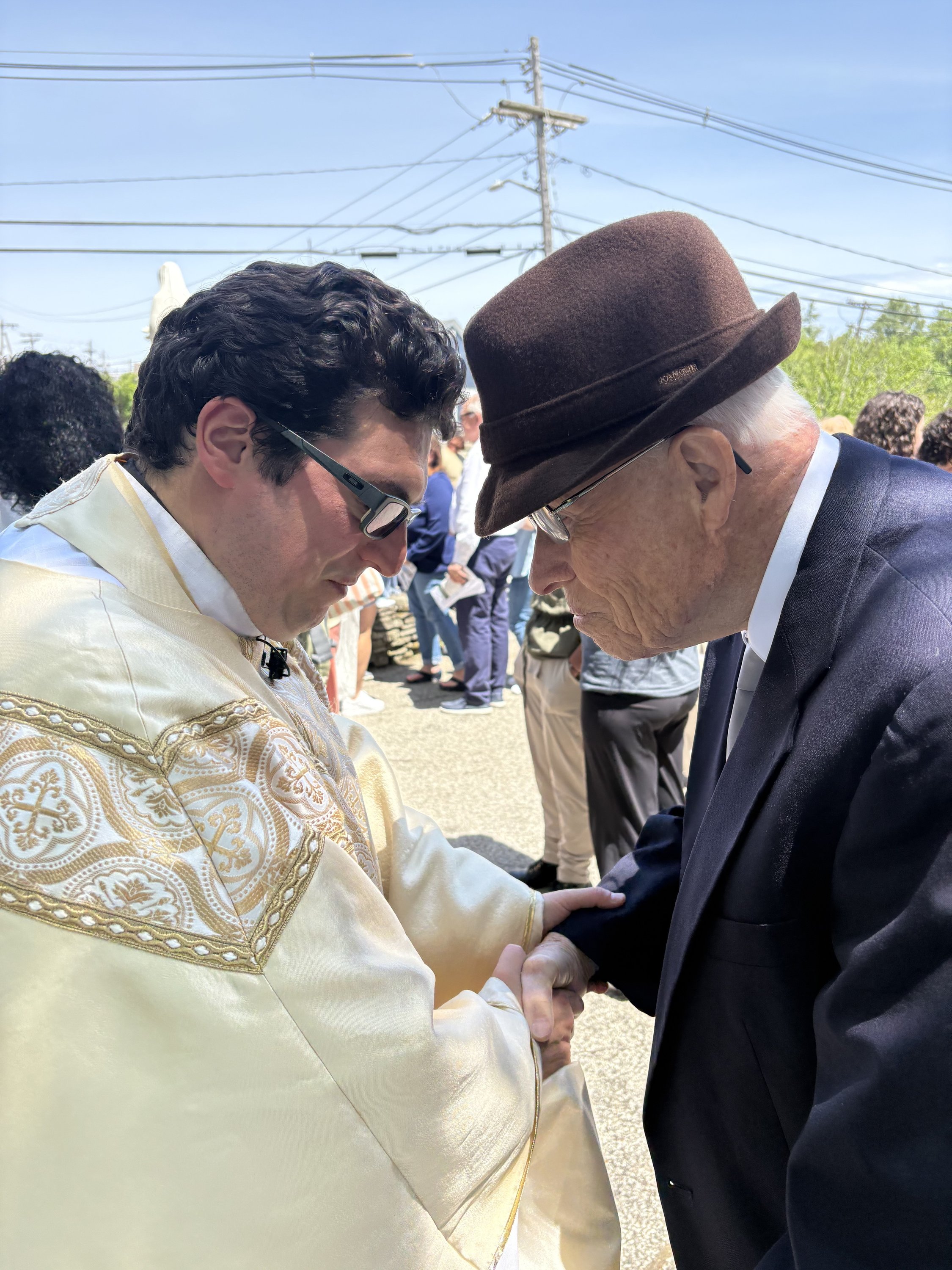
The happiest moments of my priesthood have not been moments of personal achievement as much as I sometimes think they are. They have in reality, been moments spent celebrating the sacraments, helping someone return to the faith, walking with families through difficult times, and witnessing people encounter Christ. In those moments I have discovered again and again that God’s plan is always better than my own. It’s pretty humbling. I continue to strive (imperfectly and with more than occasional stubbornness) to live out John the Baptists principle “He must increase and I must decrease”.
When I was young, a quote often inspired me: “Start by doing what is necessary, then do what is possible and soon you will be doing the impossible.” Those words have accompanied me throughout much of my life. Looking back, I see how true they have been. As a child, priesthood seemed impossible. Through God’s grace, the impossible became reality.
As I reflect upon my 10th anniversary, my heart is filled with gratitude. I am grateful to my family, teachers, formators, brother priests, parishioners, and friends. I am grateful for every person who encouraged my vocation, prayed for me, challenged me, and helped me become the priest I am today.
Most of all, I am grateful to God. After ten years of priesthood, I can say with certainty that I am truly happy to be a priest. Not because every day is easy, but because every day is meaningful. To stand at the altar, to bring the sacraments to God’s people, and to be present in both the joys and sorrows of life is a gift beyond anything I could have imagined.
As we hear Jesus ask His disciples, “Who do you say that I am?” each of us must answer that question anew. We answer not only with our words but with our lives. My prayer is that I may continue to answer that question as a faithful priest. I ask your prayers that I may remain a good shepherd, a servant of Christ, and a witness to the Gospel. I pray that all of us may grow closer to the One who first called us by name and who remains faithful through every season of life.
Ultimately, the story of priesthood is not about the priest. It is about Jesus Christ. He is the one who calls, forms, sustains, and sends. He is the one who remains faithful. And He is the one who continues to ask each of us, every day of our lives: “Who do you say that I am?”
© 2026 All Rights Reserved
Site by 